
Exoplanets
As for example for Gl 436b, some Neptune-sized exoplanets in close orbit around their host star are losing their atmosphere in the form of an evaporating atmosphere (neutral) that builds a comet-like orbital tail, interacting with the stellar wind of the host star (plasma). Transit time spectra reveal this extra neutral material and tells us about the exoplanetary mass loss.
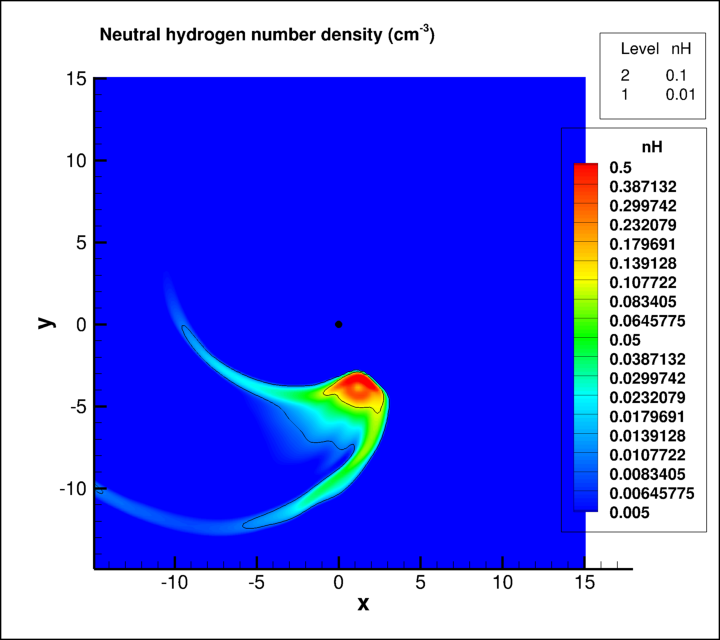
In the simulation, planetary mass loss combined with the orbital motion of the exoplanet leads to a comet-like neutral hydrogen density. The orbital plane is shown here, with the host star at the origin (black dot), and the exoplanet in an eccentric orbit around it. The length scale is in Gigameters (1E9 m).
©2003-2023 Trustees of Dartmouth College. Last updated .
For questions or comments about this website, please send an e-mail to Hans Mueller.