
Introduction
The heliosphere is a large region of space where the solar wind interacts with the surrounding interstellar gas. The plasma (ionized) component of the interstellar medium interacts directly with the solar wind. The physics of the heliosphere is made considerably more complex, however, by the presence of neutral hydrogen in the interstellar medium. It behaves very differently from the plasma; both species, however, are weakly coupled to each other. A nice introduction and review of the heliosphere by Ian Axford and Steve Suess may be found on this web page, which is part of pages dedicated to the Voyager Interstellar Mission.
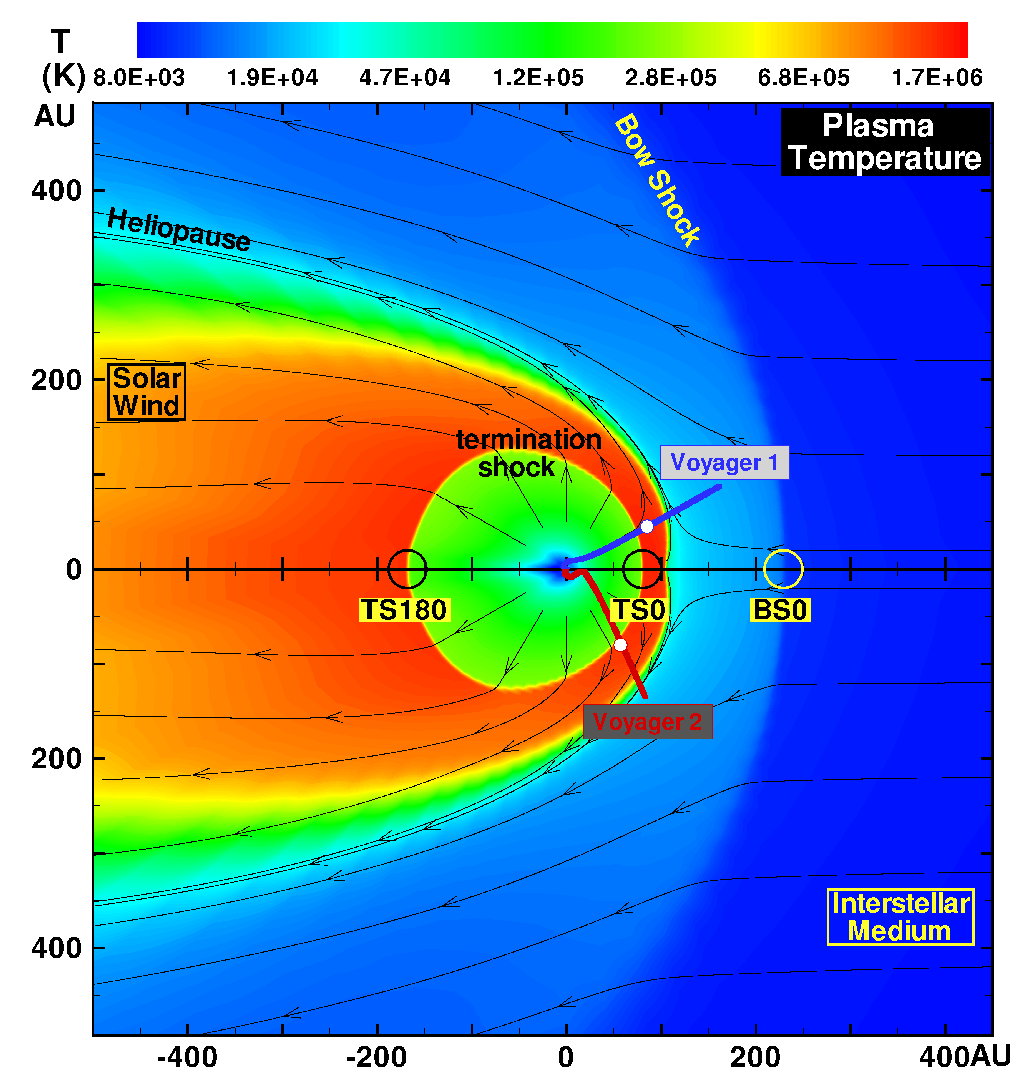
We carry out large-scale computer simulations to model this region. A typical simulation output is shown here, with the Sun at the origin and the interstellar wind coming from the right. Distances are in AU, the Sun-Earth distance; the orbit of the farthest planet (Pluto) is contained in the central blue blob.
General Structure
The Bow Shock is the line where the interstellar plasma is decelerated from supersonic to subsonic velocities. Whether or not the interstellar medium is supersonic is an open question, and consequently is the existence of the bow shock. The supersonic Solar Wind terminates at the Termination Shock where it becomes subsonic, shock-heated, and starts flowing tailward to the heliotail. A contact discontinuity, the Heliopause, separates solar wind plasma and interstellar plasma.
The interaction of the protons of the plasma
with neutral hydrogen, to leading order, is charge exchange whereby the
neutral atom loses its electron to the proton, making the latter a
newly born
neutral hydrogen atom. Charge exchange
decelerates the neutrals, filters the incoming neutrals,
and creates a hydrogen wall, an accumulation of neutral hydrogen (lower
panel) that also is heated and decelerated as compared to the ISM.

Combination plot showing plasma temperature (top) and neutral hydrogen density (bottom) in the same region. The hydrogen wall is located between bow shock and heliopause.
Numerical Modeling
The global heliosphere is modeled numerically by solving a set of
differential equations (MHD) for the plasma. Solving for the neutrals
is a more complicated problem, as the charge exchange process occurs
frequently enough to make a difference in the heliosphere, resulting in
the hydrogen wall and other effects, but infrequent enough so that
overall neutral hydrogen is out of equilibrium in the heliosphere and
needs to be described not be a single fluid, but on a more fundamental
particle level. We carry out these large-scale simulations of the
global heliosphere, with multifluid codes or with kinetic particle
codes on MPI parallel platforms.
The dynamical heliosphere
The solar wind is not steady, and its temporal variations are introducing important disturbances into the heliosphere and its boundaries. The figure above is a time-snapshot from within one cycle. Example movies that demonstrate the effect of a solar wind whose speed varies sinusoidally with an 11 year cycle are shown on this page.
©2003-2023 Trustees of Dartmouth College. Last updated .
For questions or comments about this website, please send an e-mail to Hans Mueller.