
Major News
2018: Announcement that Voyager 2 has passed the heliopause and is in interstellar space
5 November 2018 at 119.0 au JPL news storyVoyager 2 enters interstellar space
141215 Voyager 1 detects waves from heliosphere
2013: Announcement that Voyager 1 has passed the heliopause and is in interstellar space
25 August 2012 at 121.6 au Publication in Science (DOI: 10.1126/science.1241681)In Situ Observations of Interstellar Plasma With Voyager 1; Gurnett et al.
corresponding NASA story
Earlier papers:
13 Aug. 2013 A porous, layered heliopause, Swisdak et al.
Nature feature about this paper
12 July 2013 Three papers in Science (Volume 341 Number 6142 pages 144-153);
corresponding NASA story
Nature feature about Principal Investigator Ed Stone
Search for the Exit: Voyager 1 at Heliosphere’s Border with the Galaxy; Krimigis et al.12 May 2013 Recent Voyager 1 data indicate that on 25 August 2012 at a distance of 121.7 AU from the Sun, ..., Webber et al.
Voyager 1 Observes Low-Energy Galactic Cosmic Rays in a Region Depleted of Heliospheric Ions; Stone et al.
Magnetic Field Observations as Voyager 1 Entered the Heliosheath Depletion Region; Burlaga et al.
AGU press release
5 September 2013: Eleven Spacecraft Show Interstellar Wind Changed Direction Over 40 Years: press release
Publication in Science (Volume 341 Number 6150 pages 1080-1082)New Scientist writeup
2011-12: Voyager 1 nearing the heliopause
121204 Voyager 1 tastes interstellar space120905 After 35 Years, Voyager Nears Edge Of Solar System
120622 Voyager 1 at the final frontier
111205 Voyager 1 tastes interstellar space
2012: Third IBEX full skymap released
121015 3 Years of Observations from IBEX2010: Second IBEX full skymap released
100930 IBEX Finds Surprising Changes at Solar Boundary100820 IBEX Spacecraft Finds Discoveries Close to Home
Winter 2009/2010: Progress in modeling
100115 Giant Ribbon at the Edge of the Solar System091223 Voyager constraints on the interstellar magnetic field
15 October 2009: First complete set of results from IBEX
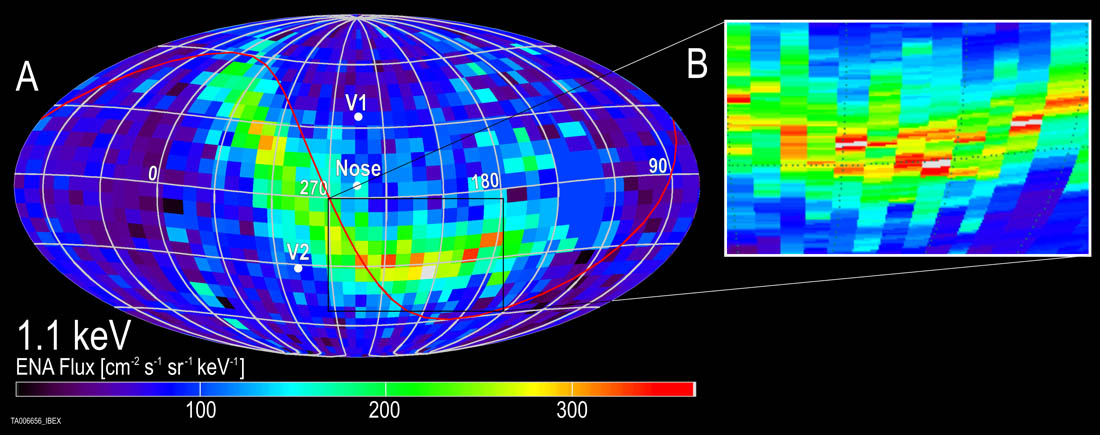
The IBEX first heliospheric results and sky maps have been presented to the scientific community and public audience. The first results are summarized in five papers published by Science Magazine. The sky maps of hydrogen energetic atoms in different energy bands show unexpected features. In addition, the IBEX team has published the first ever direct detection of interstellar neutral hydrogen and oxygen, drifting into the heliosphere from the interstellar medium.|
Further reading: |
|
|
Energetic Neutral Atom flux at 1.1 keV. Credit: Southwest Research Institute. |
19 October 2008: Launch of IBEX
The first NASA spacecraft to image and map the dynamic interactions taking place where the hot solar wind slams into the cold expanse of space launched from an Orbital Sciences Pegasus XL rocket at 1:48 p.m. EDT on Oct. 19, 2008 from the Reagan Test Site on the Kwajalein Atoll in the Marshall Islands (South Pacific, a few degrees north of the equator). The IBEX spacecraft will conduct extremely high-altitude orbits above Earth (bringing it quite close to the Moon at times) to investigate and capture images of processes taking place at the farthest reaches of the solar system. Known as the interstellar boundary, this region marks where the solar system meets interstellar space.|
Further reading: |

|
|
Artist's impression of IBEX exploring the edge of our solar system. Credit: NASA GSFC. |
30 August 2007: Voyager 2 passes the termination shock.
Further reading:
JPL news item
Publication in Nature (Volume 454 Number 7200)
16 December 2004: Voyager 1 passes the termination shock.
Further reading:
Announcement
Publication in Science press release
Additional News
120210 IBEX: detection of interstellar oxygen, neon in the heliosphere110609 Model of magnetic reconnection in the heliosheath
110428 Voyager set to reach interstellar space
110428 Message to aliens onboard Voyager
060921 Voyager 1 deep in the heliosheath
041204 Interstellar helium in the heliosphere
040727 Heliosphere: Its role as a galactic shield
040713 Voyager 1 just ahead of termination shock
040317 Ulysses extended mission
030422 Solar magnetic field at solar maximum
000424 Interstellar dust in the heliosphere
990408 Setting sails for the stars
©2003-2019 Trustees of Dartmouth College
(Updated )